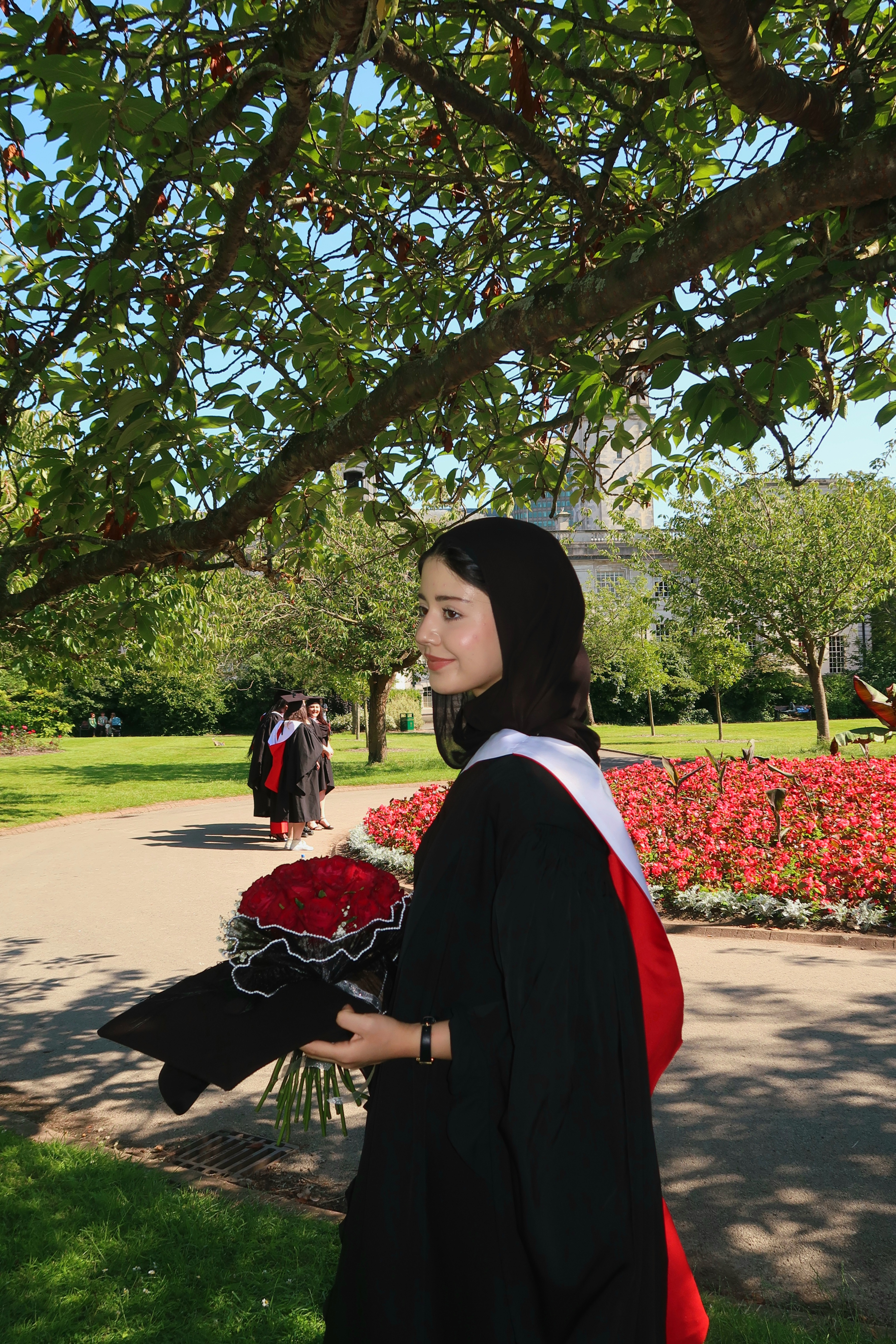
We are posting interviews with the 2024 Dissertation Prize winners. This interview is with Zohra Wardak (Cardiff University) about her dissertation “Ummatic” diaspora of diasporas? Translating the Ummah in a diasporic context through the experiences of Welsh Muslims living in diaspora.
First of all, how did you come up with your dissertation topic?
Finalising my dissertation topic was far from a linear process; my ideas at the beginning versus the end were very different. I knew I wanted to study the diaspora because of my own diasporic status, contemplating the Afghan diaspora or post-colonial diasporic flows into Wales. However, the idea of the Ummah was a later outcome of researching; I was particularly inspired by my supervisor Dr Richard Gale, who has studied and written extensively on Islam in Britain. The more I read around the geographies of religion and Islam, the more my project took shape until the final topic clicked in my head.
I was really moved by the plurality and diversity of the Muslim Ummah. Muslims come from so many backgrounds with so many experiences and stories to tell – the Muslim world is united in pain, suffering, trauma, but also a remarkable resilience that often, Western societies seem to overlook and take for granted. For example, upon first glance nobody could guess my Dad’s life story, which includes being imprisoned, tortured and narrowly escaping execution by the Soviet regime in Afghanistan. Yet, he is now on his 30th year of teaching Welsh university students about crime and justice, a rather symbolic full-circle moment! Likewise, my participants shared their families’ inspiring journeys to Wales, including the Palestinian Nakba and Naksa, and post-colonial labour flows from Africa and South Asia. Such journeys and contexts are inherently wrapped up in geography; I wanted to follow and document these colourful threads that weave the rich tapestry of the Muslim world living in diaspora. Therefore, I imagined the Ummah as this grand umbrella diaspora consisting of lots of smaller diasporas, or a diaspora of diasporas. In bridging the diaspora and Ummah, I felt my project had done something really novel within human geography and the study of society and space; Ummah is inherently a socio-spatial concept that warrants greater engagement within the geographies of religion.
Also, my dissertation write-up took place during the month of Ramadan, which really convinced me of my thematic focus. As a month of deep spiritual reflection, my dissertation became integrated as part of this reflection; I learnt so many new things about Islam from the literature and my participants, which was somehow its own unconventional yet special form of worship and God-consciousness. At its core, I wanted my project to feel deeply personal; God is unequivocally the strongest and most constructive force in my world, so I wanted to celebrate my love for Him through my writing.
What were some of the challenges you faced as a researcher? What were some of the highlights of conducting your dissertation? Do you have any tips for undergraduate students planning or doing their dissertations?
One of the biggest challenges, but eventual rewards, was finding meaning in my dissertation. My earlier ideas never felt important enough, and I kept asking myself ‘so what?’. I was becoming more and more hopeless that I wouldn’t produce something I would feel proud of, because I couldn’t imagine spending months working on a dissertation that I couldn’t connect with. This rumination cost me a lot of time and stress, because I felt that my creativity was strapped to a timebomb. I believe you cannot rush or capitalise or mass-manufacture brilliant ideas, and I specifically raised this complaint to my supervisor. I think it was difficult to contain my project’s ambition within the timeframe (and word count!) but in hindsight, it all worked out – the minute I overcame this creative block and discovered my project’s direction, the words just flowed onto the page.
The biggest highlight of my dissertation was the personal learning journey I went on. I loved every second of my participants’ time, as a mini Ummah in their own right. Their stories and experiences of practising Islam in the Welsh context opened my eyes to the resilience of the Ummah in diaspora. Being Muslim in the Western world, especially in recent decades, is a deeply complex and often troubling identity to navigate loaded with stereotypes, misconceptions and hostility. Therefore, my participants’ agency in reconfiguring non-Muslim spaces and unapologetically asserting their claim to exist was profoundly powerful for my own negotiation with my very visible and embodied Islamic identity.
In terms of advice, I probably shouldn’t admit this, but I only finalised my topic around 1.5 months before the final submission. As a perfectionist, I kept thinking, rethinking, writing, rewriting. I don’t recommend giving yourself such little turnaround time, given the many all-nighters and black coffees that I lost count of. That existential dread of meeting a big deadline is actually, believe it or not, entirely avoidable and doesn’t have to just be a part of university life! Unfortunately, it took me three years of to learn the importance of time management and strategic planning, but better late than never because my MSc has been much more enjoyable this way. In fact, unlike my BSc dissertation, I started thinking about my MSc dissertation in the summer before enrolment – I feel so prepared and ready for the module next semester! So my advice is to have a clear sense of direction in good time. At the same time however, my experience is a reminder to never compare your dissertation progress to anyone else’s – your path is the only ‘right’ path. Despite my questionable study habits, my dissertation won an RGS prize so this is a testament to stick to your truth!
Which scholars and activists had an influence on you?
Much of my geographical imagination is underpinned by postcolonial theory, particularly Edward Said’s seminal decolonial scholarship. For my dissertation specifically, I was drawn to Homi Bhabha and Edward Soja’s work on thirdspace and liminality, applying the concepts to my own intersectional identity that straddles the pluralities of being Muslim-Afghan-Female. These concepts also directly resonated with my participants’ in-between negotiation with the diasporic condition of ‘home away from home’ and their Ummatic consciousness within Wales. I also engaged with the materials and publications of Professor Khaled Beydoun, whose extensive commentary on Islamophobia, critical race theory and social justice were critical to informing my background understanding of Muslims’ experiences in the West. And as always, I am forever inspired by the brave Palestinian activists, journalists and population for their resilience to exist and resist against all odds.
Can you give us some insights into your experiences studying in Cardiff?
Studying in Cardiff was one of the best decisions I’ve ever made. When I was applying for my BSc, I received offers from London, Sussex and Swansea, but Cardiff stood out for so many reasons. Most importantly, the Welsh capital is my home – I am very proud of my Welsh identity which Cardiff University’s distinctive Welsh character deeply nurtures.
I really admire Cardiff University’s vibrant academic community as a globally-recognised institution that celebrates major research breakthroughs across diverse disciplines. Specifically, its School of Geography and Planning has been my home for what is now my fourth year. GEOPL’s commitment to research excellence and its diverse international group of academics have cultivated a dynamic and critical learning environment that I feel so privileged to study, volunteer, and work in. I was fortunate to study so many modules that expanded, challenged and even broke my ways of thinking and doing. I really enjoyed my undergraduate modules on gender, race, border spaces, development, cultural and political geography. I am really excited to be taking many of these themes with me into my MSc.
What are your plans for the future?
I have loved every second of my undergraduate and now postgraduate degree – I can’t imagine myself doing anything other than research and writing. I’d love the opportunity of a research position to study geography for a lifetime.
More broadly, I see myself having an active voice in contemporary debates related to decolonisation, the Global South and Islam. As cliché as it sounds (especially as a geographer), I really want to travel the world and immerse myself in new, different geographies. I have already been fortunate to visit so many beautiful countries which have been formative experiences in shaping my thinking, doing and being today.

 Race, Culture and Equality Working Group