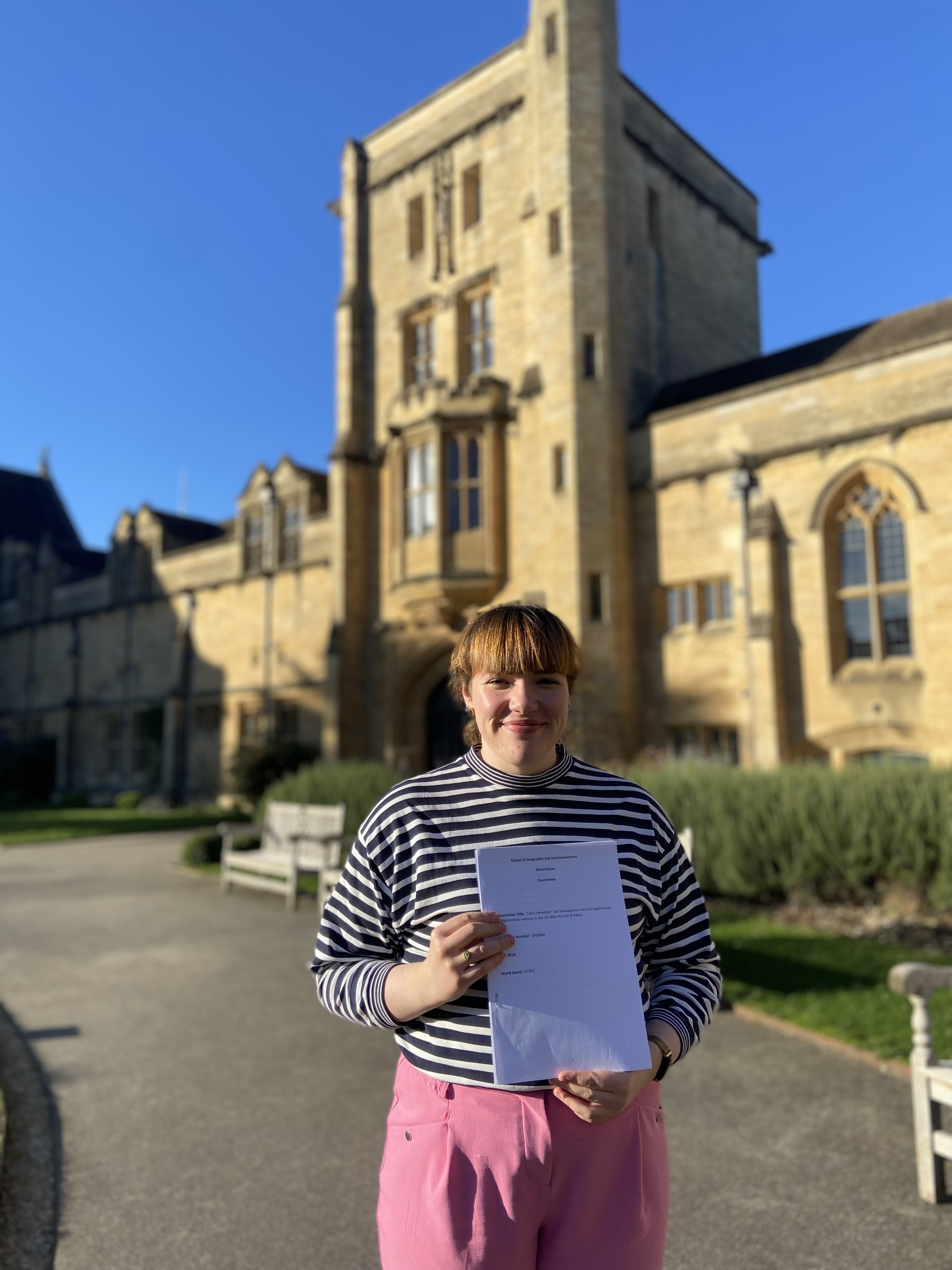
We are posting interviews with the 2024 Dissertation Prize winners. This interview is with Eleanor Luxton (pictured left with her dissertation at Oxford University).
First of all, how did you come up with your dissertation topic?
I know that this isn’t a helpful answer for undergrads who are stressing about their dissertations at the moment, but it sort of just came to me. I was having a chat with my lovely then-supervisor, Dr Suriyah Bi, and she was asking me what ideas I’d come up with. I wasn’t particularly confident in any of my suggestions, and I certainly didn’t think I’d be able to pull them off. I threw a few suggestions out there – I knew that I wanted to do something vaguely in the field of gender, ever since I first found out that there was such a thing as ‘feminist geographies’ in my first year at uni. An idea popped into my head as we were talking: what about something to do with women from Afghanistan? Suriyah thought it was a good idea, and put me in contact with another member of staff at my college who volunteered with refugees at a nearby ‘asylum hotel’. It was early 2023 at this point, and many of those who’d left Afghanistan after the fall of Kabul were still living in hotels, often in quite isolated areas. That got the ball rolling, but during the lockdown of 2020 I’d read Khaled Hosseini’s novels for A Level English so I think my interest in women’s rights in Afghanistan kind of stemmed from there. One of my earliest memories as a child is of watching BBC News whilst Taliban fighters marched across the screen of the TV – I found it really scary, and have never forgotten that feeling. Plus, as with many extremely precocious British girls who grew up in the noughties, I can vividly remember when Malala Yousafzai was shot by a Talib on her way to school in Pakistan. It was the first time I realised that lots of girls didn’t get to go to school (I loved school, shock horror). I suppose that these things were combined and subconsciously incubated for lots of years until it came to thinking about a dissertation topic.
What were some of the challenges you faced as a researcher? What were some of the highlights of conducting your dissertation? Do you have any tips for undergraduate students planning or doing their dissertations?
Completing my undergraduate dissertation was a nightmare at each and every stage. Looking back now, I can’t sugarcoat the experience, and I’m still baffled at how it all turned out so well. Because the research relied upon interviews with refugee women – who are generally defined as ‘vulnerable’ research participants by University ethics committees – I had to secure the highest level of ethical clearance from the project. This took quite a few months of editing and revising a form, and begging for help. I had to consider every possibility, from what to do in case of a data breach, up to and including how to avoid me being kidnapped by the Taliban or my participants being the target of reprisals if they were to return to Afghanistan. It was heavy stuff, but really useful and interesting, and it made the project seem more achievable in my head.
Although academics don’t talk about this a lot, research also takes an emotional and mental toll. I spent a lot of the Summer of my second year conducting interviews and chasing people up who’d forgotten that I wanted to speak to them. It didn’t feel super restful to be honest, and I emailed probably over a hundred people, asking them to take part. In the end, I conducted around 20 interviews, 3 of which were at the core of my dissertation. During the Summer, I also changed supervisors for the second time and spent a lot of time worrying that the dissertation would completely fail.
I finally submitted my dissertation in January 2024, and posted a classic cheesy photo of me smiling and holding a printed copy of it. Not long after, a torrent of abuse flooded my way, blaming me for the war in Afghanistan, suggesting that I was racist, and calling me ignorant and stupid. Why? In the dissertation I used the term ‘Afghanistani women’ rather than ‘Afghan women’, a decision made in conversation with my research participants, because the latter term can be considered exclusionary towards non-Pashtun minorities. I wasn’t expecting this Twitter backlash, of course, and luckily I had the support of my department and college.
Despite all this, there were some really enjoyable and insightful moments during the research process, and I’ve never regretted choosing this topic. The absolute highlight was getting to know women and their children in the refugee hotel I visited. We did yoga together, they tried (and failed) to teach me how to knit, we shared food, and I played football in the carpark with their kids. I chatted with the girls about school, and what their favourite subjects were, and they mainly wanted to know why I wasn’t married yet. It was genuinely joyous at times, and I wish I could have gone back more and stayed in touch. I think about them often.
Do you have any tips for undergraduate students planning or doing their dissertations?
If you’re struggling to come up with a dissertation topic, try to choose something that you find really interesting. If you don’t, you’ll end up hating the process. I was incredibly lucky to be able to conduct primary research at undergraduate level, and I know that lots of students don’t get that opportunity. But you can do really cool things with desk-based research too. And remember that your research questions and the literature you draw inspiration from will change during the course of the dissertation process, and that this is a really good and totally normal thing.
I’d definitely advise building flexibility into any schedule you create for your research – expect that things will go wrong, and be prepared to adapt your project accordingly. Don’t be afraid to write sections of the dissertation as you go along, as it’s much less daunting than saving a month at the end of your research where you have to write everything up. Keep a research diary too, so that you can reflect on your methodology and take notes on it easily. Mine was a neon pink A5 number from TKMaxx.
I’d also recommend getting a friend/family member to proofread your final copy before you submit it – my mum checked all 12,000 words of my dissertation, and I’m sure that it was better as a result (thanks mum). If you’re struggling with editing your dissertation, then come back to it tomorrow, and you’ll probably see things you couldn’t spot today. Fresh eyes, and all that.
Which scholars and activists had an influence on you?
Gillian Rose, Linda McDowell, Leanne Betasamosake Simpson, Robyn Longhurst, Katherine McKittrick, Shukria Rezaei, Lila Abu-Lughod, Lucy Mayblin, Laila Haidari, Michelle Daigle, Elaheh Rostami-Povey, Ellie Wilson, Denis Mukwege, Payzee Mahmod, Sandrina de Finney, Iris Lopez, Felix Driver, Jennifer Hyndman, Maria Lugones, Patricia Daley, Nazir Afzal, Elena Fiddian-Qasmiyeh, Arturo Escobar, Zahra Joya, Fawzia Koofi, Jess Phillips and many more!
Can you give us some insights into your student experience?
I don’t think I had a typical student experience. Studying at Oxford was never a life goal of mine, and it wasn’t until my geography teacher suggested I apply that I even considered it. I thought I’d give it a shot, and to my eternal surprise, got in. Mansfield College was a great place to study – so many really welcoming and lovely people, and I’m proud to have been part of a community that is filled with super clever state-educated folks. Oxford was a great city to live in too – everything’s walkable, and there’s lots of coffee shops, libraries and pubs. I definitely miss walking down the high street, or around college, and stopping to chat to friends I’d bumped into. The workload was tough at times, but I still think it was the right choice for me, and I’m still a massive geography geek.
What are your plans for the future?
At the moment I’m studying for an MSc in Global Migration at UCL, which I’m really enjoying. I’m hoping to travel to the Republic of Ireland this Summer to interview refugee women who’ve lived in Direct Provision, as part of my masters dissertation too. I’ve also applied for a couple of PhD studentships and scholarships in the Geography department here, so am keeping my fingers crossed for the time being.

 Race, Culture and Equality Working Group